#Traslacion2024: Roping Safety and Piety Together in a Religious Journey
- Christonette Nuevo
- Sep 9, 2025
- 5 min read

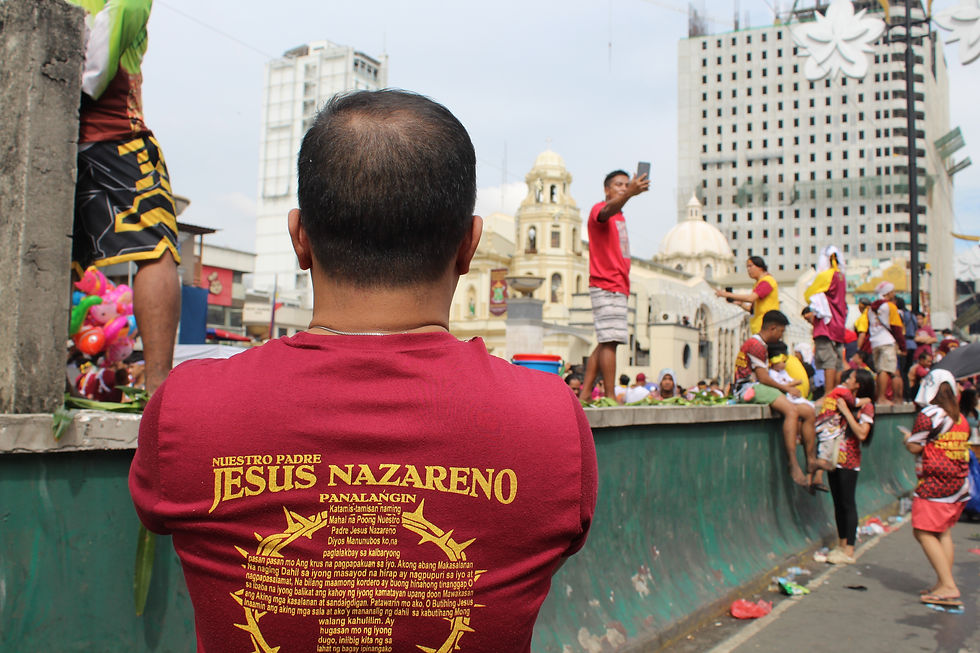
Beneath a cloudy sky, a sea of Christians converged upon the perimeter of the Quiapo church. The atmosphere was thick with passionate prayers and murmurs of faith. Maroons and yellows flooded the district in haste.
Hourly, noble men in white descend from the church to bless the devotees. “Viva! Viva!” goes the chants of men, waiting for the arrival of the sacred statue. The male volunteers of the church or hijos were the first to spot it across the street.
One of them raised his arm and pointed south of Quezon Boulevard. “Uy, ayun ba ‘yun?,” he said in a loud voice. The rest of them stood on their tiptoes to get a glimpse of the commotion. With no internet connection, none of them can tell if the Nazarene is close to its destination.
Within minutes, chaos ensues. An hijo urges the crowd to move away from the barricades. Panic-stricken mothers dragged their children away to look for refuge and aid. Men, however, ran straight to its direction. “Viva, viva!,” the yells get louder. A massive line of people snakes through the crowd of Quezon Blvd and wonder, is the blessed Nazarene here?
None of them knew it at that moment but the answer was no — it was only his rope that quickly found its way back home.
The Dawn of Devotion
On the 31st of May 1606, Christian missionaries led by the Spanish friar Benito de San Pablo set their sails down on the Philippine shore. Within their ships are various statues depicting the Passion of Christ. From the image of Jesus in the garden to his eventual suffering beneath the cross, the collection was a total delight for the eyes.
Among these is Señor Nazareno, a life-sized statue of the dark-skinned messiah kneeling below a massive wooden cross laid upon his right shoulder. According to theology professor Sabino A. Vengco Jr., its color is borrowed from the black wooden core of a mesquite tree. This type of hardwood is prevalent in many parts of Mexico where it was created before being shipped for Filipinos to see.
Prior to this discovery, nothing stopped Christians in the country from creating their own myths about the mystery. Legend has it that the statue was originally white in color before it miraculously survived a dangerous fire.
To this, Sabino says no. “The ignorance surrounding the Nazareno is remarkable,” he said in an interview with GMA News. Despite this, the image of the Black Nazarene has become an indispensable icon of religion by sparking one of the biggest demonstrations of faith for any Christian-dominated countries.
With millions of devotees, the statue was transferred from Recoletos to Quiapo upon the request of Manila Archbishop Basilio Sancho de Santas Justa y Rufina in 1767. Since then, the annual “Feast of the Black Nazarene” has included a grandiose parade to commemorate this journey every 9th of January. This is called the “traslación.”
From Luneta Park to Quiapo, the andas or carriage parades the statue in different districts of Manila. It was traditionally pulled by devotees using a thick rope created out of abaca fibers.
When a touch to its cross and shoulder seems like a faraway dream, most devotees will settle for touching this rope — or so it seems because for many years, attempts to rob to rope have been a constant feature of the traslación.
“Akala nila maganda ‘yan,” remarks an hijo of Nazareno, complaining about the irony of theft as an act of religious piety.
Paradox of Safety and Jeopardy
As the crowd dispersed over the district, the aftermath of the stampede was unveiled in plain sight. Medics and media gathered around the 78-year-old Paranaque citizen who was caught in the middle of the fight to touch the rope of Senor Nazareno. Around 6 feet to her right was a teenager weeping in pain.

Tears dropped but the rain never came.
We listened to the hijos explain how it was detached from the andas after being caught in one of its wheels. Even with more than 8 million attendees in 2024, this ordeal remains a surprise for many and more. Still, they thanked the people for not stealing it this time around, as was the case in many calendars prior.
Beyond the barricades are children cheerfully talking amongst themselves about the struggles of breathing in the stampede. Painted on their faces are unexpected smiles of triumph with the knowledge that clipped between their fingers are tiny abaca fibers.
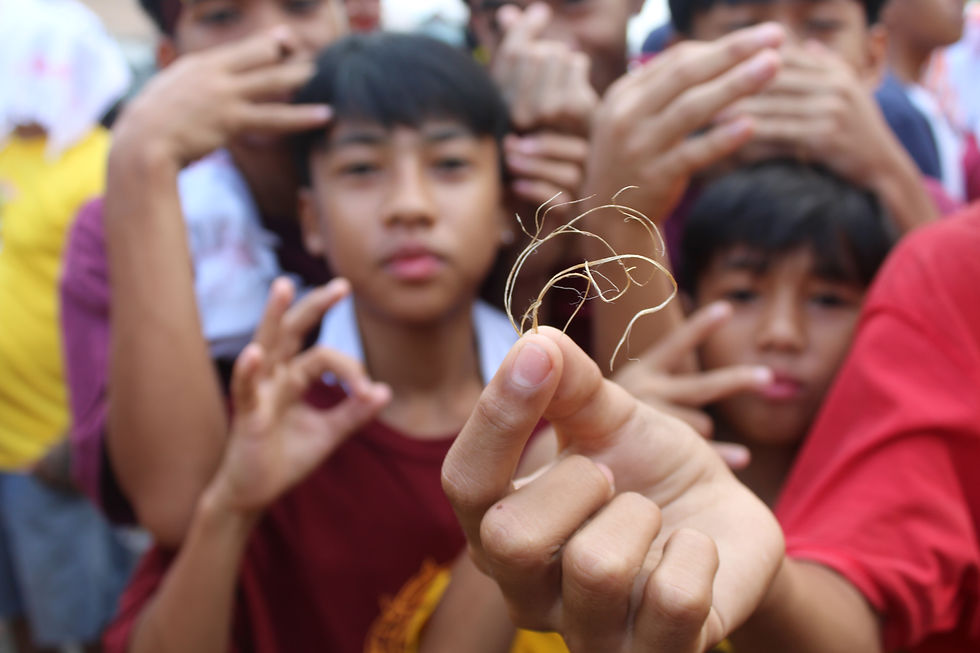
The four kids traveled 177 kilometers from Munoz to Quiapo. “Alas sais palang nandito na kami,” 13-year-old Toto (not his real name) said while pointing towards Villalobos Street where people lined up to enter the church. “Kasama namin ‘yung mga matatanda,” he added.
The four of them were caught in the stampede surrounding the centipede of adult men battling to touch the rope. Toto’s chest, in particular, was almost crushed in the commotion. Although dangerous, he insisted that the opportunity to bring a part of the rope home was an adequate consolation.
Before the four walked back to Villalobos, they shared that these fibers will go directly to their pockets. Another devotee added that this is due to the belief that the rope is sacred and offers safety and prosperity.
From midnight to late afternoon, flocks of Filipino believers pull on this cord while wishing for mercy. As they say, Senor Nazareno has as many instances of miracles as it has devotees. Each and every single hand wrapped around the rope holds a different story.
“Nakakasabik,” said a photographer from Bulacan with a red band wrapped around his head. “Talagang malakas ang pananampalataya namin [dahil] marami nang napagaling.”
For them, this year was particularly exciting. It is the first time after the pandemic years that the translacion was once again allowed to happen. Hence, the signature tradition of the rope-reliant procession continued.
The main difference was that the statue was enclosed in tempered glass. Still, that didn't stop the devotees from climbing the andas. There weren't enough police officers or volunteers to help the devotees so instead, they started believing that putting themselves in jeopardy would guarantee safety for eternity.
Still, there remains an inherent need to address this irony.
The presence and dedication of Toto and the three others are proof that beneath the cloudy skies, the sea of Filipino Christians will continue to converge upon the perimeter of the Quiapo church for many decades.
The vibrant influence of the Black Nazarene will remain frozen in Filipino tradition. As such, there needs to be a change in how we handle protection during the procession — all for the sake of young Catholic children.

Comments