Anina ng mga Alon: A tale made timeless by societal failures
- Christonette Nuevo

- Mar 19, 2024
- 4 min read
Updated: Jan 10, 2025
How the unresolved issues portrayed in the 2002 novel created a classic

Of all the artifacts housed inside an antique shop in Intramuros, a stolen sunduk stood out in its rarity. “How did it get here?” thought Eugene Evasco before picking up the lamp-looking coral sculpture used by Badjao tribes to mark the graves of their dead.
Months that followed led the Palanca-winning author to the sand beaches of Tawi-tawi where the abandoned sunduks are sold to tourists for a few-hundred pesos.
What once marked the graves of Badjaos now represent the end of a dispersed community. This is the discovery that inspired the events of ‘Anina ng mga Alon.’
As explained by Evasco in a lecture at the University of the Philippines Diliman, this is a book that took months of research to write, and a million interviews to get right. It was published in 2002. Within the same year, it won the National Book Award for Best Young Adult Literature.
For those who know nothing of Evasco’s writing and research process, whether the book was written in 2002 or 2020 will be hard to tell. After all, not a lot has changed for Badjaos since then.
Akin to the horizon of an ever-extending sea, discrimination and displacement of indigenous communities never seem to end.

A sunduk (grave marker). Photo courtesy of the Met Museum.
Life in Mindanao
The character-driven story begins with a poetic description of Anina, a young Badjao girl who breathes and lives with the sea. She is innocent, but ambitious; naive but perceptive. Unlike other kids in her community who were born and raised at sea, Anina was born on the shores of Tawi-tawi.
While writing the book, Evasco envisioned Anina’s character as a real entity that stood beside his working table, telling him what to write. “Am I a daughter of the sea or of land?” she ponders often, and so, that is what Evasco wrote about.
Lia lia lia. Ang pangalan ko’y Anina. Anak ako ng mga anak ng dagat ngunit isinilang ako sa baybay-dagat. Anak ba ako ng dagat o anak ng lupa?
— page 4
This search for identity encouraged Anina to follow her Tiya Palasia to Bongao where she enthusiastically attended school, only to get shunned by her classmates. And for the first time, she ponders if she belongs in neither sea nor land.
Discrimination against the Badjao community is well-documented. A 2020 study published in the International Journal of Innovative Science and Research Technology showed that most prejudice is centered around their appearance, language, and lifestyle.
“There are so many false claims about Badjaos — that they have gills and fins, that they’re bird-gatherers or such. These are the kinds of beliefs that I wanted to shatter when I wrote this book,” Evasco explained.
Perhaps more damaging, however, is systemic discrimination.
The Dead Sea of Manila
Forced to abandon school to help her family fend, Anina went back to Tungbangkao. There, she arrived to a fleeing community and a dying sea. Land developers have taken over her hometown.
"Kapag napunta sa ibang kamay ang ating dagat, namamatay ito." Nagkukuwento si Unggoh na nakatanaw sa mga alon ng dagat. "Balak nilang magtayo ng paaralan, paliparan, at himpilan ng sundalo dito sa ating pulo. Pinaaalis nila tayo bago magsimula ang kanilang proyekto. Saan natin ngayon ihihimpil ang ating lepa? Wala tayong laban. May papel sila."
— page 41
The dichotomy of life and death is an important recurring theme in the novel. To badjao people, the ocean itself is a living entity. It is treated with dignity. Anina herself serenades the waves with songs, flooding it with stories and memories.
When it was buried beneath unnatural land, the ocean and maritime life were not the only ones that died. So did a huge part of Badjao culture and history.
Eventually, Anina and her family were forced to flee to Manila where she had to needle through the streets with her siblings, leaving them vulnerable to illegal drugs, slavery, and sexual trafficking.
Walking through the bay, the young girl remarked:
“Tila tinatabunan ang dagat dito ng gabundok na dami ng lupa. Pinalalawak nila ang lupa.”
— page 74
Anina’s fictional life in 2002 lives on through the Badjao children of Manila in the 2020s.
Ethnic displacement persists despite the existence of Republic Act No. 8371 that is supposed to protect indigenous tribes from land grabbing and harassment. Child labor and trafficking, too, have remained rampant despite the Anti-Trafficking in Persons Act of 2003.
Fast forward to 22 years later, the same plight is faced not only by indigenous tribes but also by fishing communities all over the country.
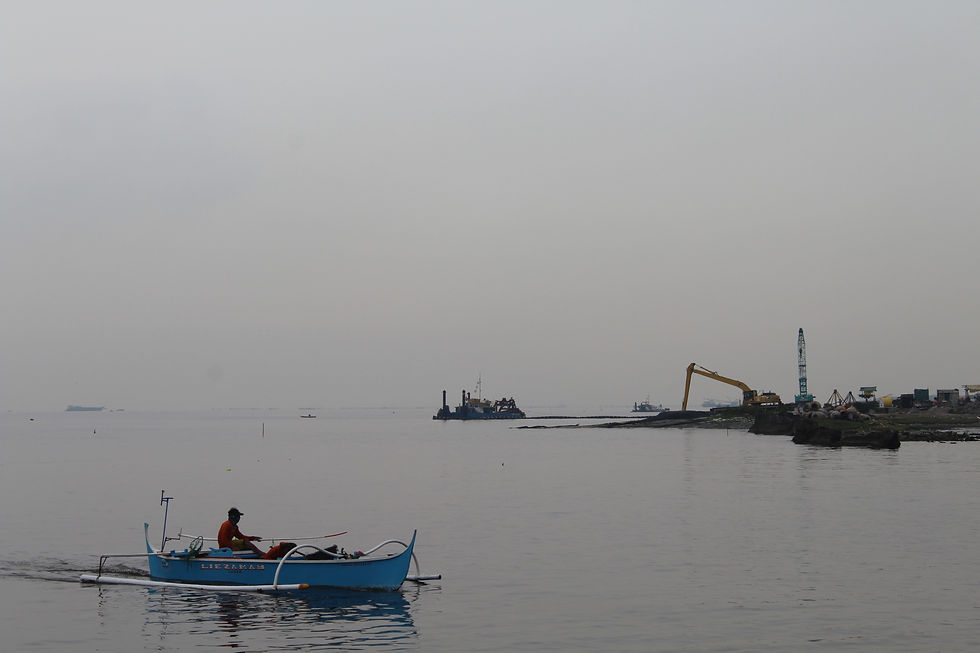
A fisherman sails past the ongoing the reclamation project in Navotas, May 14, 2023. Photo by Christonette Nuevo.
The Deathless Drawing Power of Filipino Social Realism
Social realist literature are known as exposés of reality and catalysts for a paradigm shift. However, works like Anina ng mga Alon shows us that they can also be historical documentation of stagnation
As long as these issues exist, “Anina ng mga Alon” will continue to resonate with future generations of Filipino readers in a bittersweet cascade of lives ruined by poverty, displacement, and environmental degradation.
Its timelessness is partly created from the failure to protect ethnic communities from land grabbers and human traffickers.
Today, if you often to find yourself on the roads of Balintawak, you can still meet the glassy-eyed street children of Manila and know them as badjaos, the sea people of the South.
They climb the jeepneys and distribute small, white envelopes grayed by age. Sometimes, they’ll even play the drums and sing for the passengers with a cadence they’ve carried from their hometowns.
Have you ever wondered how the waves of life led them here? Have you ever thought of the places where they came from? Have you ever wondered if any of them is named Anina?
Ipagpapatuloy ko ang aking mga awit, saanmang dagat ang muli naming kikilalanin. Ngayo'y taglay ko ang lihim na tanging kami at ang mga alon ang nakaaawit: Ako, si Anina, ay anak ng dagat.
— page 112


Comments