The Tension between Authority and Creativity in Andrew Clements' Frindle
- Christonette Nuevo

- Jan 10, 2025
- 12 min read
A Formal Literary Analysis of "Frindle"
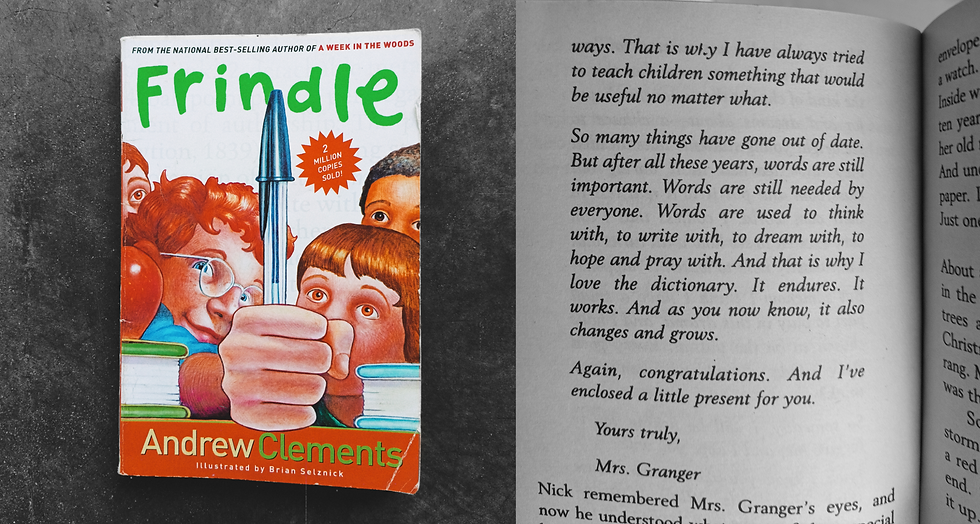
With 8.5 million copies sold worldwide, Frindle has long been a staple in elementary classrooms since its first publication on December 19, 1996 (Sandomir, 2020). The book features the playful writing of Andrew Clements with accompanying illustrations from American artist Brian Selznick who also drew the pictures for ‘The Invention of Hugo Cabret’.
The book tells the story of Nicholas “Nick” Allen, a fifth-grader infamous for his creative but sometimes disruptive ideas. It puts him, the protagonist, head-to-head with the stereotypical terror English teacher, Mrs. Granger who immediately humbled Nick in front of the class in their first encounter. In response to one of the lessons she taught in class, Nick invented the word “Frindle” as a replacement for “pen.” However, what started as a prank quickly evolved into something that neither Nick or Mrs. Granger could control. Soon enough, the new word became a national phenomenon despite the teacher's strong opposition and attempts at sabotage.
In fact, it became mainstream enough to be recognized in an official dictionary and to secure a comfortable future for Nick along the way. The story then concludes with him receiving a congratulatory letter from Mrs. Granger where she expressed her admiration and pride for her former student. She revealed that she willingly took a villainous stance to help Nick in his Frindle campaign. Inspired, Nick then established a scholarship fund in her name called “The Lorelei Granger Students’ Fund” in a gift that came with a fountain pen — or frindle — for the retiring teacher.
It is a story that explores the importance of encouraging critical thinking without ignoring the unintended consequences and changes that may follow. It also delves into the disparity between young and adult perspectives, as well as the importance of adult supervision in nurturing a child’s identity and behavior — a role that educators are naturally expected to fill. When he died in 2019 at the age of 70, it was found that Clements had already written a draft for a sequel called “The Frindle Files” where Nicholas becomes a teacher like Mrs. Granger (Sandomir, 2020).
With all of these facts established, let us now dive deeper into the setting, characterization, plot, themes, and perspectives that Clements chose to dissect in his iconic 1996 novel, “Frindle.”
Setting
Most of the story takes place in Lincoln Elementary School, an old center for learning located in a fictional town known as “Westfield” in New Hampshire, USA. Through observation, one may infer that the community that Nick grew up in could be a small one. This is substantiated by the fact that news traveled very quickly, therefore accelerating the spread of Nick’s new word.
In fact, the phenomenon itself became significant enough that local newspapers began covering the story in no time. In journalistic practice, this is only common in small cities where not a lot of breaking news occurs everyday. Clements himself eventually described Westfield in-text as ”quiet” and uneventful:
Westfield was a quiet little town. There was the occasional burglary, the teenagers got rowdy once in a while, and there was some shouting at the town council or the planning board now and then. But mostly, things were calm and orderly in Westfield, and every Thursday The Westfield Gazette proved it. (Clements, 1996, p. 57)
Meanwhile, Lincoln Elementary seems much brighter than the rest of the town in comparison. This is partly due to Nick’s constant desire to liven things up in their school, an act that is often tolerated by his younger teachers like Miss Deaver or missed by the likes of Mrs. Avery. It is because of this lenience that Nick was able to execute most of his mischievous ideas. This is a fact that remained true until he transitioned to fifth grade.
It is in this transition that Clements’ descriptive writing shines the brightest. His use of language is simplistic yet effective in portraying the shift in the mood as Nick jumps from fourth grade to the fifth.
Fifth grade was different. That was the year to get ready for middle school. Fifth grade meant passing classes. It meant no morning recess. It meant real letter grades on your report cards. But most of all, it meant Mrs. Granger. (Clements, 1996, p. 6)
Clements knew that he did not need to describe fifth-grade in great detail to build suspense; all he needed to do is to lay down every bit of intimidating change that the students will face as they move into this grade level. As observed in the quote above, he also makes no use of complex lexicon, but rather focuses on short simple sentences that are unarguably easier to read for a younger audience. This kind of writing is responsible for maintaining an air of lighthearted whimsy and youth in Frindle.
Circling back to the school setting, Mrs. Granger’s classroom is particularly important to the story because it tells the readers a lot about what kind of teacher she is. The presence of the thick, all-encompassing dictionary in front of the class creates pressure and fear amongst her students. This is a testament to the old teacher’s strict persona.
Mrs. Granger kept a full set of thirty dictionaries on a shelf at the back of the room. But her pride and joy was one of those huge dictionaries with every word in the universe in it, the kind of book it takes two kids to carry. It sat on its own little table at the front of her classroom, sort of like the altar at the front of a church. (Clements, 1996, p. 10)
This detail also directly affected the plot of the story as the massive dictionary would later inspire the conflict between Nick and Mrs. Granger. For example, it became the topic of Nick’s courageous attempt at posing a ‘delaying question’ to sidetrack the gray-eyed lady.
In general, schools and classrooms align with the overarching theme of education and learning. It is a place ripe with opportunities to explore the nuances in-between creativity and discipline, as well as authority and obedience. It is crucial in the main character’s development and the narrative. After all, the school is where most ten-year-olds spend their time and energy. In particular, the strength of the elementary school setting is especially felt when the word “frindle‘ began to circulate. Such an event is only possible through the cooperation of a young, prank-loving crowd like the ones Nick had around him. If the story was set in high school, there is a higher possibility that less people will participate.
Characterization
This analysis will focus on the relationship between the two most important characters in the book: Nick and Mrs. Granger. It will, however, consider the two within the wider context of other characters like the parents, the media, and the school.
Right off the bat, Clements decided to introduce Nick with a lore-like text that is aimed to capture or exaggerate the extent of his extraordinary persona. The first chapter established the fact that Nick is a ‘class clown’ that finds enjoyment in pranks and well-planned displays of creativity. Despite this, he remained well-liked among the student body. The first three sentences of the novel can be summarized as this: Nick is different.
If you asked the kids and the teachers at Lincoln Elementary School to make three lists—all the really bad kids, all the really smart kids, and all the really good kids—Nick Allen would not be on any of them. Nick deserved a list all his own, and everyone knew it. (Clements, 1996, p. 6)
His heightened level of critical thinking is a characteristic that endeared him to his fellow schoolmates and put him in conflict against school authorities. Nick’s inventiveness, after all, is what led him to create the word “Frindle.” However, perhaps his most important characteristic is his dedication to achieve his goals and to materialize his ideas. After all, everyone has thoughts but not everyone has the drive to verbalize them, much less to turn them into reality.
His strength is his fun-loving attitude and innovative outlook on school activities. However, there are also times when the same traits can become his weakness when pushed to its limits. Simply put, Nick doesn't exactly know where the boundary of joking ends and where discipline should begin just yet. This attitude is mostly acquired by experience. Prior to fifth-grade, Nick has never had to actually face any grave consequences for his actions. It also didn’t help that his teachers and parents are mostly tolerant of such behavior.
It will be irresponsible, however, to conclude that there is no value in Nick’s courage and critical thinking. What he needed is an authority figure that balances both discipline and encouragement. This is where Mrs. Granger becomes important.
The straightlaced teacher was introduced to the story with just as much mystique that Nick had for his own — except her description ran in the opposite direction. Her characterization plays into the stereotypical strict, dictionary-obsessed English teacher that most children encounter when they are young. She is introduced as a villainous persona, akin to how young children may perceive teachers with the same traits. In fact, there are even legends that surround her, spun by the very students she taught. This shows us exactly how much Clements understands his audience.
Everyone was sure that Mrs. Granger had X-ray vision. Don’t even think about chewing a piece of gum within fifty feet of her. (Clements, 1996, p. 7)
Nick and Mrs. Granger are polar opposites. While Nick is innovative and playful, Mrs. Granger is traditional and strict. While the former represents youthful perspective, the latter represents adult authority.
Such striking contrast is an effective ground for sowing conflict. This is something that Clements definitely intended to do with these characterizations: Nick and Mrs. Granger were meant to learn from each other. The competition between the two clashing characters allowed them both to grow and see the nuance in their respective worldviews.
This is clearly demonstrated in the turns that their character developments took in the story. As the so-called “Frindle-mania” rapidly engulfed the country, Nick began to question his decision to start the trend and to provoke his teacher. On the other hand, it was revealed later in the story that Mrs. Granger also learned how to accept change in the process.
However, this was only possible because Clements made sure that both characters are capable of change. Nick, for instance, maybe overly dedicated but he is not entirely unaffected or unaware of the consequences of his actions. This is why his attitude seemed to eventually get tamer as the chapters went by.
In contrast, Mrs. Granger stood her ground to eventually help Nick’s agenda. I believe that this ability to challenge students and to compel them to be innovative is what made her an effective educator. She taught Nick, not only language, but also the power of standing your ground. At the end of the day, it is her firm opposition that further encouraged Nick to make the frindle thing happen. It is also a form of extrinsic motivation, albeit indirect.
She is a multifaceted character. Her existence humanizes teachers who approach their jobs with strictness and deep passion for traditional teaching. The healing of her relationship with Nick is a triumph that is meant to show the readers that there are more than one ways to encourage children.
Plot
Frindle is a very well-paced story. The introduction of the main characters are memorable and Clements’ simplistic writing style is effective in establishing the setting, the mood, and the themes of the story. I argue that the rising action begins in Chapter 7, right as Nick was set to test out his new word. The chapters prior to that simply illustrate the character of Mrs. Granger and Nick.
From the introduction of such a problem, Clements built into the climax as the “frindle mania” slowly but surely seeped its way through the local culture at Lincoln Elementary School. The showdown between Nick and Mrs. Granger borders comical humor which makes the story even more exciting and enjoyable.
The tension hit its highest point or climax when media attention began to befall the quiet town of Westfield because of Nick and his new funny word. This is when Mrs. Granger got interviewed and Nick got invited to attend a sit-down interview with David Letterman, a popular American talk show host. This is a level of virality that not even Nick expected. At some point, even his father was unsure of whether things will ever be the same again in Westfield.
Perhaps to his relief, the falling action began in the chapter “Ripples” as the new word became so deeply-ingrained in local lexicon that it no longer felt as special as it once was. The frenzy had begun to die down, therefore, giving Nick and his family a chance to breathe. It was also around this time that Mrs. Granger talked to him and acknowledged his efforts, calling him a “remarkable young man.” This conversation also seemingly solved the internal discomfort that Nick has been feeling about the frindle issue.
Thanks to his little talk with Mrs. Granger—along with a healthy dose of summer vacation—Nick made a full recovery. He was proud that he had made up a new word, and he enjoyed thinking about all the commotion it had stirred up. That one little word had made fifth grade a year to remember. (Clements, 1996, p. 98)
Readers can tell that the tension has started to subside and it seems as though Nick’s transition to sixth grade has practically resolved the conflict between him and his teacher. This is an extremely realistic way of solving this conflict. Although the story is set in the 1990s, the lifespan of the “frindle mania” mirrors the lifespan of a meme. The hype disappears as soon as they peak in popularity (Karlsson, 2019). In real life, things are not rarely resolved in a decisive manner, sometimes they just fade out. The same is true for the tension between the student and his teacher.
However, this is not the end of Nick’s story. He would go on to receive an important letter from Mrs. Granger, an object that may be likened to a time capsule. This is perhaps the emotional peak of the entire book because it fulfillingly concluded both character arcs. The revelation of Mrs. Granger’s intention was heartwarming. It recontextualized the entire story and relationship between the two. Coupled with Nick’s reciprocal act of appreciation towards his former teacher, it makes for a really memorable and inspiring ending.
Themes
The first primary theme of the book is education. It shows us the invaluable role that educators play in shaping the attitude, strengths, and future of children. Thus, making it a complex profession, best represented only by a likewise complicated character such as Mrs. Granger.
Her character development imparts a healthy message because it subverts the stereotype of the “terror teacher.” It shows the readers that such educators have a reason for their approach to teaching, while also reminding them to remain open to change. Although things ended well in this novel, it must be noted that there is always the danger of completely discouraging children from being creative critical thinkers like Nick. Hence, Mrs. Granger’s decision to uplift and support her student in the end is an important aspect that must not be overlooked.
Second, Nick also represents children’s natural desire to challenge authority through will and critical thinking. He is known for questioning and challenging the arbitrary nature of certain rules imposed upon him by adults like Mrs. Granger or even the dictionary itself. Nick’s ability to think outside the box is largely encouraged and vindicated in the story. Through his triumph, Clements sent a clear message to his audience: creativity is worth it.
Point of View
The story of "Frindle” is told from the third-person limited point of view. Meaning, there is an external narrator who primarily discusses the thought bubbles of the protagonist, Nick Allen.
His thoughts, feelings, dilemma, and motivations are clearly presented which allows the readers to sympathize with his cause and to understand clearly the thought process that goes into his decisions. This perspective makes it easier for the intended younger audience to resonate with Nick’s cause as a protagonist. It is a window to his imaginative mind that builds empathy for him and his growth. It makes rooting for Nick easy. The primary strength of this POV is its ability to shape the reader's connection to the main character.
Moreover, this limitation is also what made the reveal in the end possible. This point-of-view allows the readers to digest the story’s themes and plot points at the same pace as the main character does, therefore giving more weight to Mrs. Granger’s revelatory letter at the end of the novel.
However, the author also understands that Nick is still a child whose grasp of the world is not yet fully developed. This is why Clements made sure that there remains a comfortable distance between him and the reader — to avoid moralizing all of his actions and to give children the opportunity to be critical. It will allow them to learn from the consequences of Nick’s actions. Besides, the third-person limited perspective also offers more flexibility when it comes to storytelling. It basically allowed the author to also explore the thoughts of Nick’s parents and even Mrs. Granger herself without distracting from the narrative focus.
Conclusion
“Frindle” is an inspiring book that advocates for the place of creativity in education. It imparts an important lesson that may be digested not only by students but also the educators who decided to explore the story for themselves.
Its strengths lie primarily in its impeccable pacing and characterization. Both Mrs. Granger and Nick Allen are memorable characters that are further enhanced by the conflict they share in-between. It is good that the author pivoted away from taking a side but rather showed the importance of both innovative and traditional thinking. At the end of the day, it was never about winning for the two main characters, it was about challenging themselves and their personal beliefs.
This is why I would recommend this book to Grade 5 readers who are about to enter the sixth grade as well. First, it is because Nick himself is a fifth-grader, thus, students within the same grade level are most likely to draw a more realistic connection between him and their own experiences. The second reason is because of the way Frindle was written. It is simple and inspiring. It has a multifaceted character in Mrs. Granger, however, even her character is not nearly complex enough to match the level of perception required of higher or lower grade levels.
In conclusion, “Frindle” is an effective story that will encourage students to hone their critical thinking skills and to develop their personal strengths. It is highly enjoyable in its simplicity but ripe in the message and themes it wishes to impart. Even a fifth-grader can tell that it is a story written out of appreciation for education, therefore earning its rightful place in elementary classrooms.
References
Clements, A. (1998). Frindle.
Karlsson, A. (2019). The rise and demise of a meme : A study on what a meme is and why people are spreading them. DIVA. http://www.diva-portal.org/smash/record.jsf?pid=diva2%3A1342276&dswid=-895
Sandomir, R. (2020). Andrew Clements, 70, Dies; Wrote Best-Selling Children’s Books. The New York Times. https://www.nytimes.com/2019/12/15/books/andrew-clements-dead.html

Comments