Janus Silang, The Filipino Boy Who Lived
- Christonette Nuevo

- Jan 10, 2025
- 12 min read
A Formal Literary Analysis of “Si Silang Janus at ang Tiyanak ng Tábon'
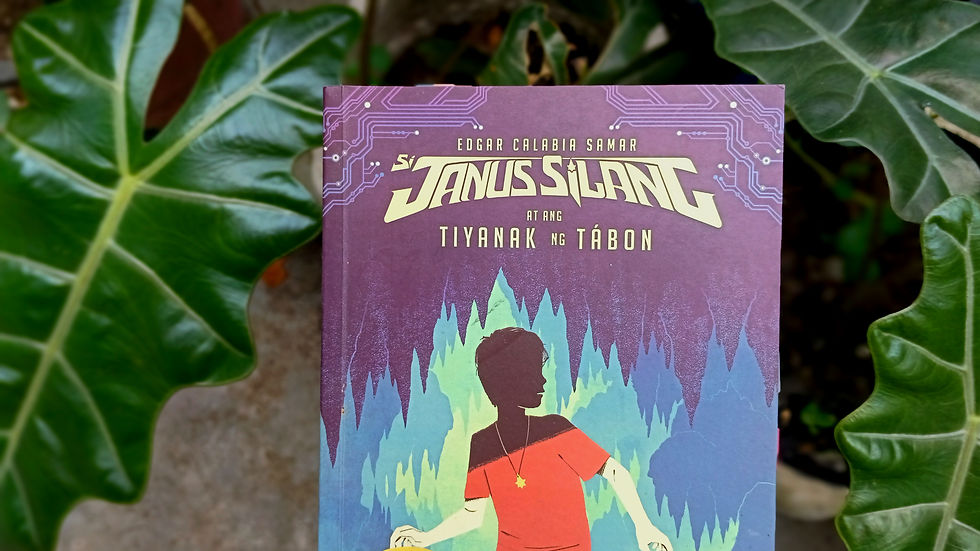
Originally published in 2014, the young adult novel “Si Silang Janus at ang Tiyanak ng Tábon'' is the most recognizable body of work written by Palanca-winning poet Edgar Calabia Samar. The book would go on to birth two sequels within the span of three years before it was adapted into theatrical format by Tanghalang Ateneo in February of 2017 . The fourth and fifth installments of the Janus Silang series were distributed by Adarna House in 2019 and 2021 respectively.
The plot-driven story begins with the bizarre deaths of the main character’s friend and four other opponents in the online RPG game called the Terra Anima Legion of Anitos (TALA). Succeeding chapters then follow Janus in his reluctant quest to uncover what happened to the victims. His desperation and curiosity led him to the hands of Renzo and Manong Joey who promised to explain everything.
After following them to Manila, Janus found out that he might be one of the only people in the world who can locate Tala, before her enemies do. He also discovered that his father was killed and replaced by a do-ol three years ago, right around the time that he started hurting Janus. Perhaps even more heartbreaking is the revelation that his sweet, doting little brother — Juno — is the tiyanak. All of this was revealed to Janus within a single day that ended with him watching Juno devour her mother’s innards.
Surprisingly, the book doesn’t end with the tiyanak’s defeat. Instead, it closed with Manong Joey’s promise to protect Janus and the teenager’s vow to finish TALA. Fueled by determination and hunger for justice, they left the town of Balanga to visit the house of Manong Joey in Angono, Rizal.
Setting and Writing Style: World-building with Words
The story takes place in the town of Balanga, Bataan where five teenage gamers were found dead after competing in a TALA tournament. Janus was the only participant who miraculously survived the sudden deaths. He immediately went home that night, terrified.
Bataan is an important detail because the lore of Bungisngis, a one-eyed mythological creature that yields laughter as his weapon, originated in Orion, Bataan. True enough, it also turned out to be a pivotal character in the story. Janus and his friends referred to a mysterious elderly man as Bungisngis in the beginning of the novel. However, it wasn’t until the later chapters that he was revealed to be Manong Isyo, the Bagani brother of Manong Joey.
The author used vivid adjectives to build suspense and create an overall atmosphere of unusual ghostliness in Balanga following the tragedy. His description of a lone Bungisngis in the rotonda was particularly haunting.
Samar’s poetic background is especially evident in his diction, often opting for satisfying internal rhymes embedded within run-on paragraphs. The short, almost staccato-like length of descriptive sentences is also reminiscent of poetry.
“Malamig ang hangin. Mamasa-masa ang lupa dahil sa mahinang ambon [...]. Akala nga nila’y bubuhos ang ulan. Pero makapal pa rin ang ulap hanggang ngayon. Nagbabadyang bumuhos anumang oras. Walang buwan, ” (Samar, 2014, p. 5).
In the example given above, the author purposely wrote a pause in the middle of a potentially run-on sentence [“Akala nga nila’y bubuhos ang ulan / pero…”]. This is done to emphasize the phonetic similarities between ‘ulan’ and ‘buwan’, as well as ‘ambon’ and ‘ngayon.’ This kind of subtle but poetic phrasing is consistent throughout the whole text.
Rain is also a pivotal recurring theme throughout the whole novel. It was always there every time that someone was about to fall victim to the conniving tricks of the tiyanak. It was raining when Harold was killed. There was a storm when Renzo saw the monster for a second time. The sky was also bawling on the night that Janus’s mother was murdered.
This is a classic literary way of building mystery, suspense, and horror. It shrouds Balanga in the same cloud of gloom that embraces fictional cities like Gotham and real places like Seattle. More importantly, this detail is accurate to real weather patterns in the Philippines. The book is set in August, smack dab in the middle of the rainy season that usually starts from June to November (PAGASA, n.d.).
Although the book began with unhurried pacing, the final events and revelations happened within a single day, the Saturday that Janus decided to meet Joey. It is also condensed in the last few chapters of the book, giving it an impression of a whiplash experience.
Plot: The Pitfalls of Fantasy Pacing
Unfortunately, Janus Silang at ang Tiyanak ng Tabon somehow fell victim to the most common illness of fantasy novels: excessive exposition. Fantasy authors, both foreign and local, usually spend a lot of time building the world and explaining their lore in the first book. This often results in problematic pacing and overutilization of explanatory paragraphs. The same is true for Samar’s book.
This is not entirely disadvantageous, in fact, it may even be necessary for this genre. However, almost everything that Janus knew of the tiyanak and the existence of mythical creatures was explained to him by Manong Joey, Renzo, and the tiyanak itself. There are even instances in the second half of the novel wherein one dialogue took more than one and a half pages. He barely discovered anything on his own. Even the ‘comics’ were underutilized when it had the potential to reveal the lore to Janus in a more interesting manner.
In picking this route, Samar indirectly spoon fed the lore to his readers. This also contributed to the feeling that the latter half of the story was rushed.
Although the book began in a climactic tragedy, the story itself started really slow. The first four chapters were dedicated to the aftermath of what happened in Malakas Computer Shop and Janus’ role was to be an observer: watching the news, listening to adults and pretending like nothing happened. Perhaps, this is an attempt by the author to establish the mystery and in a vacuum, this pacing is completely reasonable — if not for the fact that the novel only had 11 chapters.
After a thrilling introduction to the story, it took 5 chapters before another plot-relevant event happened: when Janus received a message from Joey. The first 149 pages of the book was allotted to introduction and rising action, leaving only 30 pages for the climax, falling action, and denouement.
On the flip side, Samar has mastered the art of foreshadowing. For example, the readers are first told that Juanito’s behavior (Janus’ father) changed three years ago. Then, they are informed that Renzo also met the tiyanak three years ago. Finally, it was revealed that he has been dead for three years, therefore weaving the aforementioned details together. This is excellent pacing from a revelatory standpoint.
The climax of the story was reached when his son discovered the truth. The readers then followed Janus, Renzo, and Manong Joey back to his house in Balanga. Within the last two chapters, they captured the do-ol, the tiyanak killed Aling Josie, her funeral started and ended, and Janus was adopted by Manong Joey.
Samar ended the book not by resolving the conflict but through the foreshadowing of more. This type of cliffhanger is a common and excellent way to wrap up the first part of a fantasy series. It keeps the readers curious, engaged, and hungry for continuation. Although effective in its purpose of maintaining readership, the ending may feel incomplete to some because the main character’s story did not have a complete arc. I will circle back to this point in the succeeding section.
Perspective and Characterization
This analysis will focus on Janus Gregorio Silang, the 13-year-old boy who stood in the middle of everything. The story is told mostly from his perspective, albeit in a third person limited point of view. Meaning the readers can access the emotions of Janus in every scene. For the entirety of the story, the confusion and curiosity are shared between the two. Samar wrote the story in such a way that when the main character is surprised, so are the readers. When he cries, so will the readers. This is a deliberate decision, often present in plot-driven stories because it allows the audience to discover pieces of information at the same pace that the main character does.
One may argue, however, that the same effect can be achieved if Janus was the direct narrator of the story. After all, this is a common thread among popular foreign YA novels. The Percy Jackson series, the Hunger Games, Divergent, and Kane Chronicles are all written in first-person. The fact that Samar chose this perspective is interesting. The closest possible comparison is probably the Harry Potter series, which is also written in the third-person limited point of view.
To understand this choice further, we must first understand the identity of our eponymous main character.
Relatability and Filipino Culture
Typical of a fantasy lead, Janus also started out as an ordinary boy tangled up in extraordinary situations. He is a young high school student who loves playing online games, hanging out with his friends, and nurturing his budding relationship with a girl, Mica.
Janus is an effective lead character because he exhibits realistic behavioral patterns common to Filipino youth as observed by local social psychologists. His attitude, struggles and interests mirror those of the target audience who are most likely around the same age.
For example, the act of changing one’s behavior as a result of group pressure is referred to as “conformity” and it is commonly observed in school among adolescents (Macapagal et. al, 2017). While Janus’ decision to play TALA wasn’t caused by peer pressure per se, it is still a fact that he only started playing it after his fellow DOTA teammates switched to the game. Additionally, the collective attempt to get better at one thing by sharing information amongst each other is known as social facilitation. In the book, Janus and Harold both got better at playing TALA through collaboration.
Another important aspect of his social life is love. What Mica and Janus had is most colloquially referred to as mutual understanding or “M.U.” Academics describe this courting phase as a “gradual process of developing emotional intimacy through time,” (Macapagal et. al, 2017, p. 79). Although it was obvious from the beginning that Janus found comfort in Mica’s companionship, they weren’t officially together. Instead, the relationship between the two is still in development and has a very slow pace.
Most importantly, his most dominant and consistent character trait is also consistent with the traits of average Filipino teenagers. Review of literature done by Macapagal et. al (2017, p. 39) shows that unlike Western counterparts, the development of social self in Filipino youth is still heavily influenced by family relations.
Family conflict is a major theme in this book. There is one between Janus and his father. There is one between the tiyanak, the Tabon man, and its mother. There is one between the first Bagani and his son. Most importantly, there is one between Tala and the Tiyanak.
Family and Survivor’s Guilt
This plays into the wider family-oriented culture of Filipinos. It was established early in the novel that despite his rebellious streak, Janus remained family-oriented. He loved his mother and tried not to hold a grudge against his father. His actions were heavily influenced by their expectations. Thus, he struggled to keep up and to balance it with his own self-expression. Most notably, the author went out of his way to build up a strong relationship between Janus and Juno, his 6-year-old little brother who he believed to be his father’s favorite kid.
“Hindi binabanggit sa kaniya nang tuwiran pero laging ramdam na ramdam ni Janus, lalo pa mula sa Papa niya, na laging mas magaling si Juno. Mas mabait. [...] Pero hindi naman niya magawang magalit sa bunsong kapatid,” (p. 37).
His treatment of Juno is emblematic of his emotional maturity. He doted on him like a good older brother. He valued his opinion more than anyone, including his parents. It is evident that one of Janus’ primary motivations in the novel is keeping Juno safe and setting a good example for him to follow.
This is where the advantage of a third-person perspective is most poignant. It is the most convincing way in which Samar can feed the readers more information while also ensuring that the main character remains oblivious and unsuspecting. For the majority of the book, Janus was in a position wherein he would never suspect his brother to be capable of anything evil. Meanwhile, it was heavily foreshadowed to the readers through Juno’s bizarre behavior and lack of interaction with Aling Josie that there is something different about him.
However, it is important to understand that Samar’s choice of perspective is enhanced by the fact that he has mastered the art of expressive language — once again, a testament to his poetic roots.
For example, the lines about the manananggal’s tongue piercing through Janus’ heart were very memorable because it visualizes the character’s survivor’s guilt. As explained earlier, Janus is a character with high emotional intelligence which somehow allowed him to suppress and hide his emotions after what happened in Malakas as a coping mechanism. The manananggal’s tongue, however, is a reminder that his chill facade is not impenetrable. It is a reminder that caging the guilt and fear that he has inside his heart is not sustainable.
Samar also foreshadowed Janus’ pivotal role in finding Tala early in the book. He is characterized to have the exact traits that the Pusong had in the game. He is a great decision-maker, has incredible awareness of his weaknesses, and a moral compass that is dictated by the need to keep his family members safe, a natural inclination to protect people.
All of this contributes to the gravitas of what the ending reveals to both Janus and the readers. It made the shock, trauma, and betrayal that befell Janus in the last chapter of the book realistic and relatable, making it easier for the readers to identify and root for him in the future.
The ending implies that his story is only about to begin. However, it must be noted that Janus did not have a meaningful character development in this book, making the ending seem lackluster in terms of character arc.
Harry Potter and the Philosopher’s Stone ended with the death of Quirrel and Voldemort’s escape. Through that, the young wizard accomplished something and established himself as the chosen one. Katniss Everdeen won the hunger games. Percy Jackson brought the lightning bolt back to his father. Tris Prior also lost her mother by the end of Divergent. However, she also had to kill one of her friends to survive. All of these endings provide a satisfying conclusion to a well-executed character arc.
This begs the question: what exactly has Janus accomplished by the end of this book?
One may argue that his initiative to get back on track with his education after the tragedy was character development. Perhaps, even his decision to pursue the truth and go to Manila can also count as such. Another relevant scene is when he tried to finish TALA for the sake of his family. However, all of these are disconnected. From beginning to end, Janus was a victim to circumstances, rather than a player in his own game. For someone that is ever-present in the story, he remained an underdeveloped character.
Conclusion
Still, these criticisms do not distract from the overall enjoyability of the novel because “Si Silang Janus at ang Tiyanak ng Tábon” is a plot-driven, not character-driven story. It dabbles into local mythology, culture, and history like its foreign counterparts and it does so in a way that exudes ingenuity.
Before diving into the story, it is difficult to shake a negative expectation that a videogame-based plot may not be executed well without falling into the category that the younger audience may refer to as ‘cringe.’ One of the biggest achievements of this book is evading that label. Samar was able to integrate fantasy, mythology, gaming, and online culture into one promising premise without sacrificing appeal. This is perhaps best demonstrated by how he seamlessly weaved mythology into each level of Tala, a move that is already prevalent in other RPG games. It shows adequate understanding of gaming and its culture. The texts and chats between characters were also not overdone, but rather remained realistic or within expectations.
The results of the most recent National Readership Survey (NRS) showed decline in non-school book readership and alarmingly low interest for YA in the Philippines (Ombay, 2024). They provided no data to differentiate between the statistics for local and foreign YA books. However, it will not be unreasonable to assume that demand for locally produced works in this genre is even lower.
With that said, I would love to recommend this book to readers between the grade levels of 6 and 10. I believe that intermediate to young adult readers will appreciate it because it is the kind of work that is guaranteed to exceed expectations; the kind that stops you on your track to say “wow, this is unexpectedly great.” I am confident in its potential to raise expectations and interest not only for the author but for the entire genre.
There is also the developmental aspect of reading: this is a kind of book that one may read for pure leisure. This is especially crucial for intermediate learners who are starting to read for learning and may be bombarded with information-heavy texts. The introduction of such a relatable, engaging, and age-appropriate book will help them create the habit of reading.
As a reader, I really felt Samar’s respect for his audience, for himself, for the characters, and most importantly, the subject matter. I thoroughly enjoyed the book despite my few criticisms. The cliffhanger left me wanting more, not only from the series but from the whole local industry of young adult literature.
References
De La Cruz, C. (2017, February 23). Janus Sílang’s tips on how to kill a tiyanak. spot.ph. https://www.spot.ph/arts-culture/performing-arts-2/69389/tanghalang-ateneo-janus-silang-a00171-20170223
Macapagal, M.E.J., Montiel, C.J., Ofreneo, M.A.P., & Nolasco, J.M. (2017). Social psychology in the Philippine context (3rd ed.). Ateneo de Manila University Press.
Ombay, G. (2024, March 21). Non-school book readership among Filipinos drops in 2023 —survey. GMA News Online. https://www.gmanetwork.com/news/topstories/nation/901265/non-school-book-readership-among-filipinos-drops-in-2023-survey/story/
PAGASA. (n.d.). Climate in the Philippines. https://www.pagasa.dost.gov.ph/information/climate-philippines
Samar, E. C. (2014). Si Janus Silang at ang Tiyanak ng Tabon (7th ed.). Adarna House, Inc.
Comments