Mussel Memories: Navigating the Last Mussel Farms in Tangos
- Christonette Nuevo

- Jan 10, 2025
- 9 min read
Written by Christonette Nuevo, Paulo Dayandante, Vinni Gandia and John Andrei Sanchez
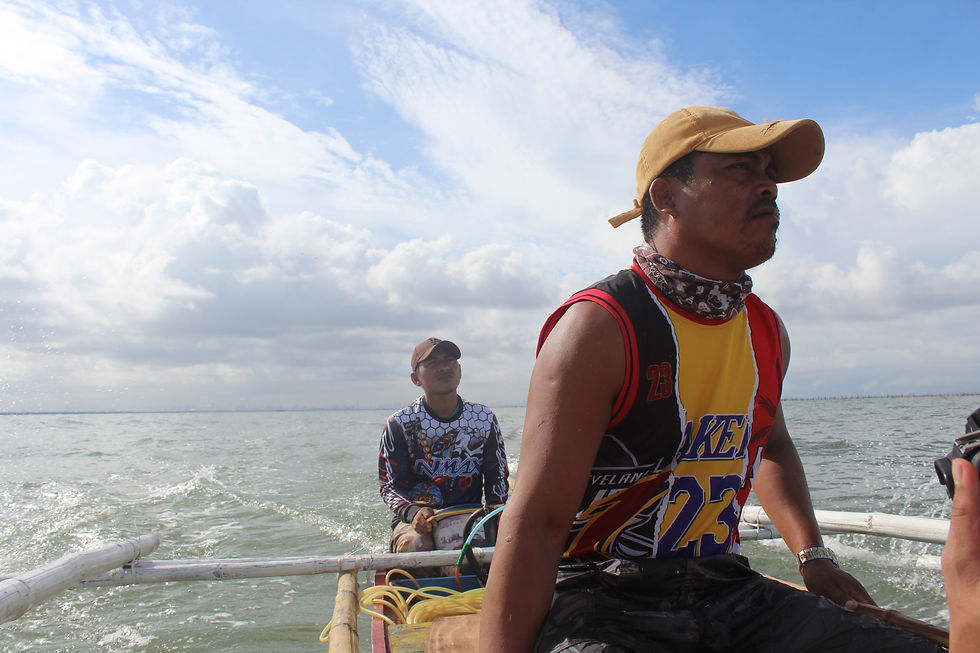
For Michael Cabanza, the world is no longer his oyster.
With goggles for eyes and flippers for feet, the mussel farmer dove under the newly built lines of baklad or fish corrals standing perpendicular to the waters of Wakas, the name appropriately given to his last tahungan spot.
What once was a long array of a 150 baklad has now sunk down to just 80. Sooner or later, perhaps nothing will be left.
After almost half an hour, air bubbles rose around the fish corrals. Cabanza and his brother-in-law, Daryl, ascended back to the surface, boasting small-netted sacks of tiny mussels which they poured at the front section of their boat.
Cabanza and brother-in-law Daryl plunge themselves into the sea to harvest mussels on June 11, 2023.
Photos by Christonette Nuevo.
The two mussel farmers live at the northern end of Navotas City in a town known as Tangos. At the fishing capital of the Philippines, most Navoteños derive their livelihoods directly and indirectly from fishing and other related industries.
For many years, the same has been true for Cabanza and his family. The city used to be home to a thriving mussel industry that has now been reduced to less than half of its peak production.
Gone are the days when groups of mussel farmers would sail together on a big boat in the morning and share a massive sum of income by noon. Someday, gone will be the days of even simply seeing the horizon from the coastline of Tangos.

Bothered by the storm developing near the shoreline of town, they soon led us back to the coast where we first met Cabanza.
As we neared the pundohan or what the Tangos locals call their small port, yellow and black tractors could be seen operating on the site of the Navotas Coastal Bay Reclamation Project. One day, it will make a graveyard out of this sea, burying it beneath 650 hectares of artificial land and commercial facilities.
After almost a decade of mussel farming, Cabanza was forced to let go of all his baklad three months ago amidst pressure from the San Miguel Corporation (SMC) that oversees various reclamation projects around Manila Bay, including the very same one on their proverbial doorstep.
However, perhaps even more disheartening to Cabanza and to the rest of the mussel farmers is the sheer negligence of local authorities.
“Pinabayaan na kami. Kahit lumaban pa kami, wala ring mangyayari,” he said.
Scoping the Project
Massive cargo ships can be spotted from the shoreline of Tangos, carrying either a combination of sand, gravel, and soil, or heavy equipment such as bulldozers and backhoes.
As we headed back, Cabanza wondered how such a big construction site could just pop out of seemingly nowhere. “Bilis nga oh, ayun oh. Marami pa tahungan diyan dati oh. Ngayon, wala na eh,” he explained as he points out the old location of hundreds of now-demolished baklad.
However, the project was in fact planned for decades.
Conceptualization and proposals for a reclamation project along the city’s coastline began as far back as the 1960s, according to Navotas City Planning and Development Office head Engr. Rufino Serrano.
Serrano says this is the local government unit’s (LGU) way of adapting to the lack of available lands and open spaces for development in their city. “Maliit lang naman kasi yung Navotas…so kailangan namin talaga na magdagdag ng lupa. Kaya madalas lumalabas yang issue na reclamation,” he explained.
After a number of failed attempts, the dump-and-fill project only saw the light of day when investors and builders from the Ramon Ang-owned conglomerate SMC entered the picture in 2015.
The ongoing Navotas Coastal Reclamation Project is now a joint venture project between the Navotas LGU and the Argonbay Construction Company Inc. (ACCI), a subsidiary under the SMC Infrastructure.
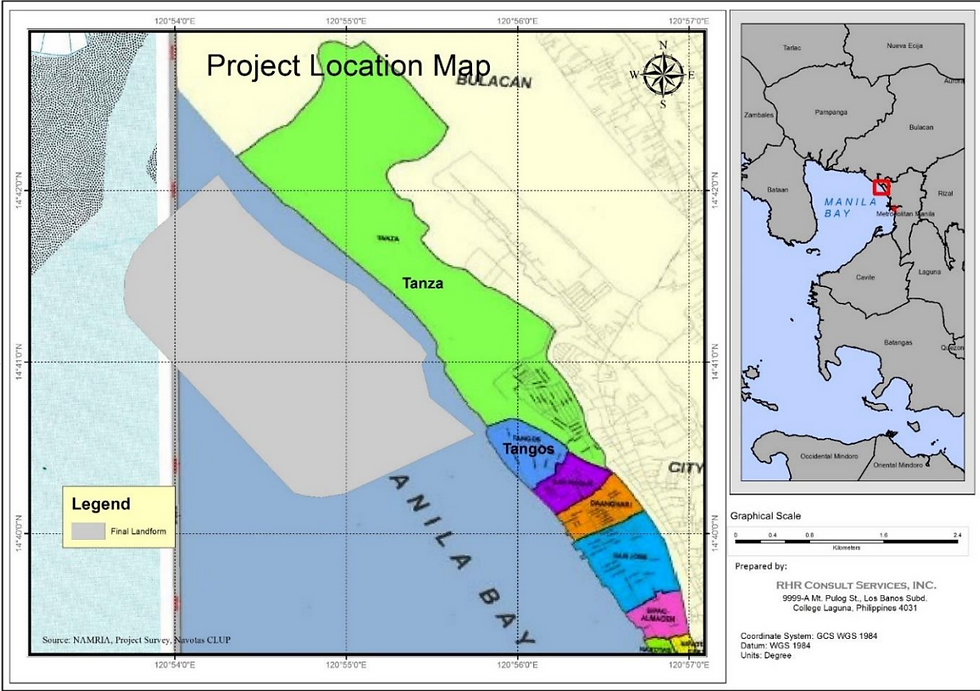
Navotas Coastal Bay Reclamation Project Map. Source: EIS Summary for the Public (ESP) | Navotas Coastal Bay Reclamation Project
The 650-hectare development area is divided into two sections, with the first amounting to almost 577 hectares which will completely block off the coastline of Tangos’ neighboring barangay, Tanza. Meanwhile, nearly 74 hectares of reclaimed land will act as a path for transportation to the main area of reclamation, extending from Tangos all the way to the edge of the city.
The latter section is the reason for the removal of baklad of more than 200 mussel farmers in the area. Yet this stretch of water is a necessary route for local fisherfolk. Due to its privatization, fishermen will be forced to travel farther than usual.
Otherwise, they could get penalized or worse, jailed for trespassing.
The Environmental Impact Statement of the project states that “it is envisioned that the area would be developed primarily as an industrial complex that includes other mixed used developments of commercial, residential, institutional, port or port-related facilities and tourism establishments.”
This particular project is only a part of the bigger coastal development plan of the Navotas LGU.
“Sa Navotas Coastal Development po dadaan ang EXPRESSWAY papuntang New Manila International Airport at ito ay tatayuan ng 3,480 units na PABAHAY - ang pinakamalaking pabahay project natin sa Navotas!” then Navotas mayor and current Rep. Tobias Reynald ‘Toby’ Tiangco said in a March 2022 Facebook post.

ACCI is currently carrying out the reclamation process through a combination of hydraulic dredging as well as land filling in the area.
Engr. Serrano clarified that all of these plans went through the proper processes which included public hearings with all concerned parties such as the Tangos residents.
However, opposition from Cabanza’s family and the rest of the Tangos community is well-documented.
Shrinking Future
Almost a year ago, Cabanza would earn between P5,000-P10,000 a day depending on tahong sales. Now, the veteran mussel farmer can no longer rely on it as his only source of income.
Because of the rainy season, he needs to wait until December for a steady harvest of mature mussels after being forced to transfer his tahungan farther out in the sea.

“Sa totoo nga po, tatlong buwan na po kaming hindi nakakabayad ng renta...Kaya todo kayod po kami para sa mga anak, para sa mga gastusin. Kahit mahirap, kailangan eh,” explains Ging-ging, wife of Cabanza.
For the meantime, the couple buys tambakol, burot, turay, bilog and galunggong from fellow fisherfolks and sells it in the market. This is one of their new ways of supporting their two children who are both studying in high school.
Daily life has become a game of chance for the Cabanza family, a reality shared by many households in Tangos.
They are just among the over 35,000 Tangos residents affected by the massive reclamation project in Navotas. A lot of them have been displaced and relocated, while some have entirely lost their only source of income.
Danilo Lopez*, 51, has been working in a mussel farm since he was 12. Five years ago, he fulfilled his dream of owning his own tahungan after almost four decades of long labor. SMC swept away his hard work into nothing
"Mababa na yung sampung banyera [ng tahong]. Mga nasa P1000 ang isa non…Yung 60% sa’kin, yung 40% sa mga kasamahan ko,” Lopez said.
Now, he cannot even seem to figure out how his current P600 daily earnings can sustain his six kids, three of whom are attending college.
Affected residents tried to defend their livelihood by staging a protest last September 2022 to renounce the reclamation project but to no avail. Navotas police blocked the residents from voicing their concerns in front of the city hall.
“[H]inarang kami agad ng pulis…Di naman po kami hinarap ni Mayor. Binalita pa na NPA kami. Hindi naman po totoo. Hindi lang po kami pinakinggan kaya pinili po naming mag-protesta noong araw na yun,” said Ging-ging.
This is far from what Engr. Lacsamana said in an interview that Mayor John Reynald Tiangco faced the protesters and explained the benefits of the projects to calm down the people. The Navotas government continues to compel the community to adapt livelihood alternatives.
“Meron na rin kaming training centers para ide-dedicate kung anong mga kailangang skills sa itatayong reclamation projects. Sa ngayon nga po ang usapan is priority na i-hire doon sa area na iyon ay from Navotas,” said Engr. Janice Lacsamana, the acting head of the City Environment and Natural Resources Office (CENRO).
While Lopez and other former mussel farmers corroborated this claim, the promise of a new livelihood remained just that — a promise. Disillusioned after nearly a year of waiting, they started seeking out new sources of income on their own.
SMC provided a meager amount of money as ‘payment’ to the demolished farms. Reality is that not even half of the capital amount Cabanza and Lopez spent in building the mussel farms was given to them by the corporation.
According to Cabanza, some mussel farmers felt compelled to accept the payment following threats from SMC that the Department of Environmental Resources (DENR) would eventually remove their baklad regardless.
The relocation initiatives of SMC are also mired by unjust compensation. Resettlers were only given P15,000 to build new houses despite the high cost of construction materials.
“Ako po, iyong P15,000, kawayan ko lang…yang mga ganyan pong pamposte. Tapos iyong ibang mga kahoy ko nanghingi na lang ako sa tahian,” explained Angela Nadenas, a resident relocated because of the SMC project.
As of press time, SMC Infrastructure and the DENR Metropolitan Environmental Office-North have not responded to our requests for interviews. They instead referred us to the Navotas LGU, the primary proponent of the reclamation project.
Behind the Reclaimed Horizons
There are currently 187 reclamation projects across the country, at least 30 of which are based in the Manila Bay with various stages of developments.
Even the alamang industry in Tangos claimed to be affected by the non-stop seafloor dredging activities in the area.
“Dati, nakakapuno kami ng 10 palangganang alamang, pero nung dumating yung SMC, halos hirap na kaming mapuno yung lima,” said Nanay Mariefe, an owner of one of the alamang processing sites in Tangos.
Alamang industry in Tangos. Photos by Christonette Nuevo.
According to the Navotas LGU, the goal of the project is to not only secure profits for the city but also to offer better job opportunities for all the Navoteños by providing them with necessary skills other than fishing.
However, environmental scientist Dr. Rene Rollon pointed out that more than the financial gains, it is critical for public officials to consider the city’s identity in relation to its life sources.
“I am not against or anti-reclamation but I believe that you should only do it if it’s at least absolutely necessary. Yes, kikita ang LGU, ang developer, baka rin ang siyudad. Pero overall you diminished the culture of the community. Binura mo ‘yung resources na nandyan.”
“They’re not really quantifying the environmental and sociocultural value. Actually, invaluable yun eh.” Dr. Rollon added.
Pambansang Lakas ng Kilusang Mamamalakaya ng Pilipinas (Pamalakaya) National Chairperson Fernando Hicap also questioned the initiative’s rationale. "Kung naglikha man ng trabaho diyan, anong klaseng trabaho ang meron? Karamihan ng manggagawa diyan ay kontraktuwal. Walang security of tenure, walang benefits," Hicap said.
While the environmental groups recognize this as a small footstep, they continue to urge the government to still revoke the projects that previously received environmental compliance certificates (ECCs) from the DENR.
“Dapat tuluyang pahintuin ng gobyerno ang reclamation sa Manila Bay dahil it really threatens the socio-economic rights of the fisherfolks, marine biodiversity, and food security. Baka kasi maging pansamantala lamang ang hakbang na ito,” Hicap said.
Due to concerns raised in the Senate along with increased public scrutiny, the DENR temporarily stopped accepting new applications for future reclamation projects. However, the moratorium does not cover already ongoing land-and-fill projects along Manila Bay.
DENR Secretary Antonia Loyzaga recently said in a briefing on June 5 that the department is “reviewing what had already been permitted. We’re trying to understand how the lessons learned from these activities can actually inform actions and policies moving forward.”
After his initial loss of baklad in 2023, Cabanza built another tahungan over the waters of Bulakan, Bulacan where the local government promised to grant them the permit to operate.
Still, the sky remains dim ahead of Tangos mussel farmers. The 80 lines of fish corrals over Wakas is Cabanza’s last

In a sea that reflects the entire life of a community, burying it is the same as depriving people like Cabanza and his family of chances of welcoming a hopeful sunrise.
Ang huling magtatahong— for some, it may sound like a noble title. But for the mussel farmers and fisherfolk in Tangos, it mirrors a story of untold threats, uncertainties, and valor amid a development plan that threatens their decades-long way of life.
The stories of Cabanza, his family, and his town are as rich as the once abundant supply of mussels in Navotas. Without concrete mitigation measures, they—like mussels during a storm— will one day be fully swept away by waves of corporate greed and state neglect.
*The former mussel farmer requested to remain anonymous for this story.
Comments